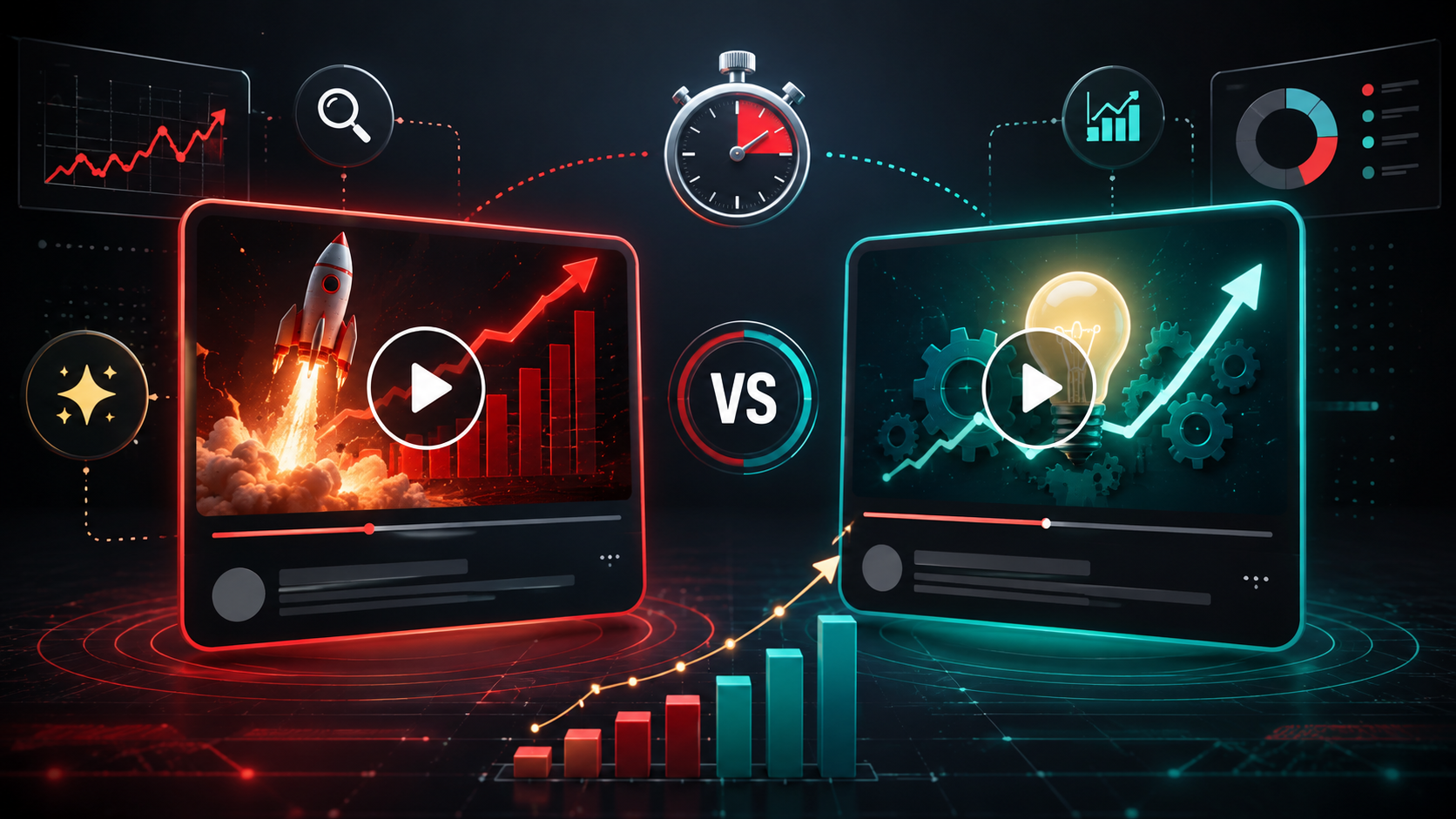
For most of YouTube's history, creators got one shot at a title and thumbnail before publishing, with no reliable way to know whether a different choice would have performed better. That changed in stages between 2023 and 2025, and by mid-2026 the platform's built-in Test and Compare tool has become one of the most consequential free features inside YouTube Studio — now covering titles as well as thumbnails, open to any eligible creator, no subscription required.
At a glance
Tool: Test and Compare, built into YouTube Studio
What's new: Title testing now runs alongside thumbnail testing in one workflow
Cost: Free — no YouTube Partner Program membership needed
Eligibility: Advanced Features enabled (identity verification) on desktop only
Variants: Up to 3 titles, 3 thumbnails, or 3 combined pairs per video
Winning metric: Watch time share, not click-through rate
Typical duration: 1–2 weeks per test
Rollout: Expanded to all eligible creators globally in December 2025
Beyond YouTube: Platforms like Vidanalyze run testing through the YouTube Data API, extending it to 5 variants and multiple videos at once
What changed: from thumbnails-only to a full packaging test
YouTube's testing tool didn't start out covering titles. The company previewed thumbnail comparison testing at VidCon in 2023, then widened access through 2024 as "Thumbnail Test & Compare," well before title testing existed. For nearly two years, a creator who wanted to test one title against another had to lean on a paid third-party tool that simulated an A/B test by rotating versions on a schedule — not a true side-by-side split.
That gap started closing in mid-2025, when YouTube began experimenting with title testing inside the same interface, limited at first to a small percentage of creators. By December 2025, the company expanded title testing globally to every creator with Advanced Features enabled, folding it into the same tool used for thumbnails. Heading into the tool's second year, that combined feature is now the default way most channels evaluate their packaging before it goes wide.
How Test and Compare works
Setting up a test happens entirely inside YouTube Studio on desktop, either during upload or on a video that's already live:
Open the video in YouTube Studio and go to the title field or the thumbnail panel.
Select A/B Testing, then choose Title only, Thumbnail only, or Title and thumbnail.
Upload up to three variants — an existing title or thumbnail can count as one of the three.
Confirm the test. YouTube rotates the variants across viewers automatically from that point on.
Editing the title or thumbnail manually outside the tool while a test is running stops that test immediately, and it has to be restarted from the beginning.
The metric that surprises most creators: watch time, not clicks
Most third-party split-testing tools optimize for click-through rate — the share of viewers who click after seeing a title or thumbnail. YouTube's native tool deliberately does not. Test and Compare measures watch time share instead, crowning the variant that keeps viewers watching longest per impression rather than the one that simply earns the most clicks.
YouTube frames this as a guardrail against clickbait: a version that inflates clicks but sends the wrong viewers to a video will lose out to a more accurate, better-matched version once retention is factored in. It's a meaningful departure from CTR-first tools, and it means a title that looks like the "safe" pick on paper can still lose a test to a more honest one that undersells the video but pulls in the right audience.
Who's eligible, and what can't be tested
Access is tied to a channel setting rather than subscriber count. To run a test, a channel needs:
Advanced Features enabled in YouTube Studio, which requires identity verification (phone number or government ID).
An eligible video type — public long-form uploads, podcast episodes, and saved livestream archives all qualify.
Several categories are excluded outright: YouTube Shorts, scheduled Premieres (until they convert to a standard upload), videos marked Made for Kids, age-restricted (18+) content, and private videos. A video that later converts into a Short loses access to any test that was running on it.
Reading the results
Results appear on a video's Details page and in the Reach tab of YouTube Analytics, where "Manage test" shows live standing while a test is still running. When a test concludes, YouTube reports one of three outcomes:
Result | What it means | What happens next |
|---|---|---|
Winner | One variant clearly produced more watch time, with enough data to be statistically confident | The winning version is applied automatically to all viewers |
Performed the same | Variants finished close enough that there's no clear best option | The creator can pick a preferred version, or leave the default in place |
Inconclusive | Not enough impressions, or too little difference between variants, to draw a conclusion | The first variant uploaded becomes the default |
Throughout the test, YouTube holds back a small control group that only ever sees the original title and thumbnail; their behavior is excluded from the results so it doesn't skew the comparison.
Most tests resolve within one to two weeks, depending on how many impressions a video generates. Guidance based on real-world use of the feature suggests aiming for roughly 1,000 to 5,000 impressions per variant before treating a result as reliable — lower-traffic videos may need the full two-week window, or longer, to reach a clear answer.
Practical guidance for running a better test
Test older, already-published videos first to limit the impact of a weaker variant on a channel's overall numbers, then move to strategically important uploads once you trust the process.
Make variants meaningfully different. Swapping a single word or a minor color rarely creates enough of a behavioral gap for YouTube to call a winner; a stronger approach pairs a keyword-driven title against an emotional or curiosity-driven alternative.
Avoid changing anything else mid-test. Editing a description, end screen, or thumbnail outside the test alongside a running title test makes it harder to isolate what actually drove the result.
Upload high-resolution thumbnails. Any variant below 720p causes every thumbnail in that test to be downscaled to 480p, which can quietly disadvantage otherwise strong options.
YouTube Test and Compare vs. Vidanalyze: which should you use?
Credit where it's due: Test and Compare is the official, most deeply integrated option, and it's built directly into the upload flow every creator already uses. For a single video and a straightforward thumbnail swap, it's free, requires no extra setup, and remains the right place to start. The trade-off is scope — three variants, one video at a time, and a significance calculation YouTube keeps internal.
That's the gap platforms like Vidanalyze are built to close. Vidanalyze isn't part of YouTube's internal serving layer, so it can't replicate the exact mechanism YouTube uses — splitting live traffic to a single video between viewers in the same moment. Instead, it runs experiments through the YouTube Data API: it uploads each variant, applies it to the video with the thumbnails.set endpoint, holds it for a set window, pulls impressions, CTR (where YouTube Analytics exposes it), views, watch time, and average view duration, then rotates to the next variant. Once every version has had a turn, it compares the full data set and recommends — or automatically applies — the strongest performer.
Worth being upfront about: because that's a scheduled rotation rather than a true concurrent split, it can pick up more day-of-week or time-of-day noise than YouTube's own method. Vidanalyze offsets that with controls YouTube doesn't expose at all:
Capability | YouTube Test and Compare | Vidanalyze |
|---|---|---|
Max variants per experiment | 3 | 5 |
Test types | Title only, thumbnail only, or both | Title only, thumbnail only, or both |
Multiple videos in one experiment | No — one video per test | Yes — bulk video IDs supported |
Schedule control | Fixed by YouTube (up to ~2 weeks) | Creator-set duration (24h, 48h, 72h, 7 days, or custom), plus a custom rotation interval in minutes or hours |
Confidence threshold | Internal, not disclosed | Set by the creator |
Minimum impressions before calling a winner | Internal, not disclosed | Set by the creator |
Winner handling | Automatic only | Auto-apply winner, or adaptive rotation that shifts traffic toward the stronger variant as data comes in |
Metrics collected | Watch time share only | Impressions, CTR (where available), views, watch time, and average view duration |
Cost | Free | Included in Vidanalyze plans, with a free tier available |
For one video and a quick thumbnail check, YouTube's own tool covers it. For a channel running several experiments at once, testing five directions instead of three, or wanting to see the actual confidence level and sample size behind a "winner" rather than taking YouTube's word for it, Vidanalyze's A/B Testing Engine is built for that next level of control.
Frequently Asked Questions
What is YouTube's Test and Compare tool? It's YouTube Studio's built-in A/B testing feature. Eligible creators can upload up to three versions of a video's title, thumbnail, or both, and YouTube automatically shows each version to different viewers before applying whichever produced the most watch time.
Is YouTube's title and thumbnail testing free? Yes. There's no separate subscription or YouTube Partner Program requirement — only a channel with Advanced Features enabled through identity verification.
Does YouTube's A/B test use click-through rate or watch time? Watch time share. YouTube picks the variant that keeps viewers watching the longest per impression, not the one that generates the most clicks.
How long does a YouTube A/B test take? Typically one to two weeks, depending on how many impressions the video receives. Lower-traffic videos may take the full window, or longer, to produce a statistically reliable result.
Can I A/B test YouTube Shorts? No. Shorts, scheduled Premieres before conversion, Made for Kids content, age-restricted videos, and private videos are all excluded from testing.
What happens if my test doesn't produce a clear winner? YouTube reports either "Performed the same," where variants finished within a normal margin of each other, or "Inconclusive," where there isn't enough data to draw a conclusion. In the inconclusive case, the first variant uploaded becomes the video's default, and creators can still change it manually at any time.
Can I A/B test YouTube videos outside of YouTube's own tool? Yes. Platforms such as Vidanalyze run tests through the YouTube Data API — rotating title and thumbnail variants on a schedule and pulling the resulting analytics — which allows for more variants (up to 5), multiple videos in one experiment, and creator-configurable confidence and impression thresholds that YouTube's native tool keeps internal.
Google Preferred Source
Add Vidanalyze to your trusted publications and get our news directly in your Google feed.